
How SongSwift Approaches Systems Discovery

|
Category: Discovery & Process Author: Adam Clark Miller Publish date: 2026-04-01 |

Systems discovery is where operational complexity becomes clear enough to design against.
That is the simplest way to describe what discovery is for. It is not a vague strategy exercise, and it is not just a requirements-gathering session with new language. It is the work of understanding how the operation actually functions, where the strain points are, what the system must be able to represent, and what constraints should shape the design before build decisions are made.
When the real problem comes into focus
For many organizations, this is the moment where the real problem finally comes into focus.
By the time a team reaches discovery, there is usually visible pain already. Processes feel fragmented. Reporting is harder than it should be. Staff are compensating manually for gaps in the system. AI may be under consideration, or the business may be weighing a new platform, a custom workflow layer, or broader operational redesign. There is usually no shortage of proposed solutions.
What is often missing is a clear view of the system itself.
Starting with the reality of the workflow
That is where SongSwift begins.
The first question is not what to build. The first question is what the workflow is actually doing.
That sounds obvious, but it is surprisingly easy for organizations to operate for years without a shared understanding of how work truly moves. The documented process may differ from the lived process. Formal roles may not match how decisions are really made. Edge cases may be handled through informal workarounds. Critical reporting requirements may rely on logic that was never structured intentionally in the system.
Discovery starts by making those realities visible.
Mapping how work actually moves
That typically means looking closely at the flow of work from initiation through resolution.
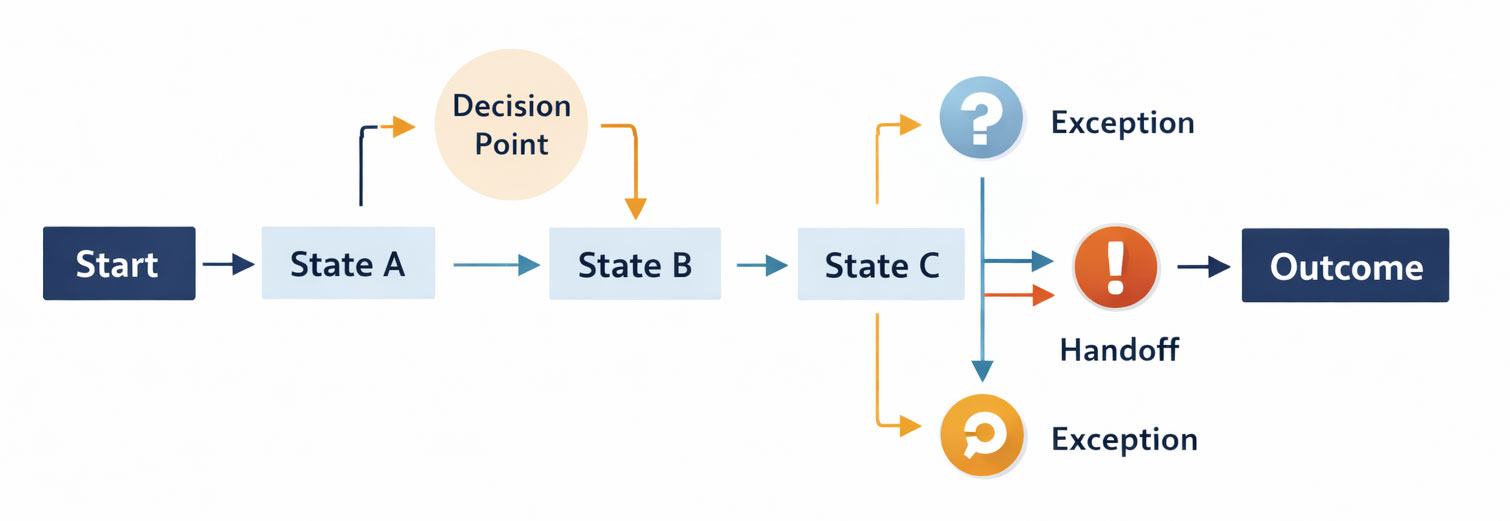
- What information enters the process?
- Who touches it?
- What decisions are made along the way?
- Which states matter?
- Where do handoffs occur?
- What exceptions appear regularly?
- What supporting context is required for good judgment?
- What downstream actions depend on the result?
The aim is not simply to document activity. It is to understand the operational shape of the system.
Identifying bottlenecks and hidden issues
Once that shape begins to emerge, bottlenecks become easier to diagnose.
Some are obvious: too many manual steps, too much duplicated entry, too many disconnected tools.
Others are less visible. A reporting problem may really be a state-definition problem. A workflow delay may actually be a permission problem. A recurring exception may expose unclear policy logic. A proposed AI use case may depend on source data that is too inconsistent to support reliable automation without redesign.
These are the kinds of issues discovery is meant to surface early.
Understanding constraints as part of the design
SongSwift also looks carefully at constraints.
Every meaningful system operates under them. There may be compliance requirements, legacy data dependencies, historical reporting needs, cross-team coordination issues, approval structures, change-management realities, or practical limits on what can be replaced all at once.
Constraints are not inconveniences to wish away. They are part of the design environment.
How priorities actually get set
That is why discovery is not only about identifying opportunities. It is also about identifying what must be preserved, what cannot be broken, and what tradeoffs the organization is actually willing to make.
Priorities are shaped through that lens.
Not every pain point should be solved at once.
Not every useful feature belongs in the first phase.
Not every elegant architecture is justified by the business context.
Discovery helps distinguish between what is essential, what is desirable, what can wait, and what would create unnecessary complexity if introduced too early.
What a strong discovery process produces
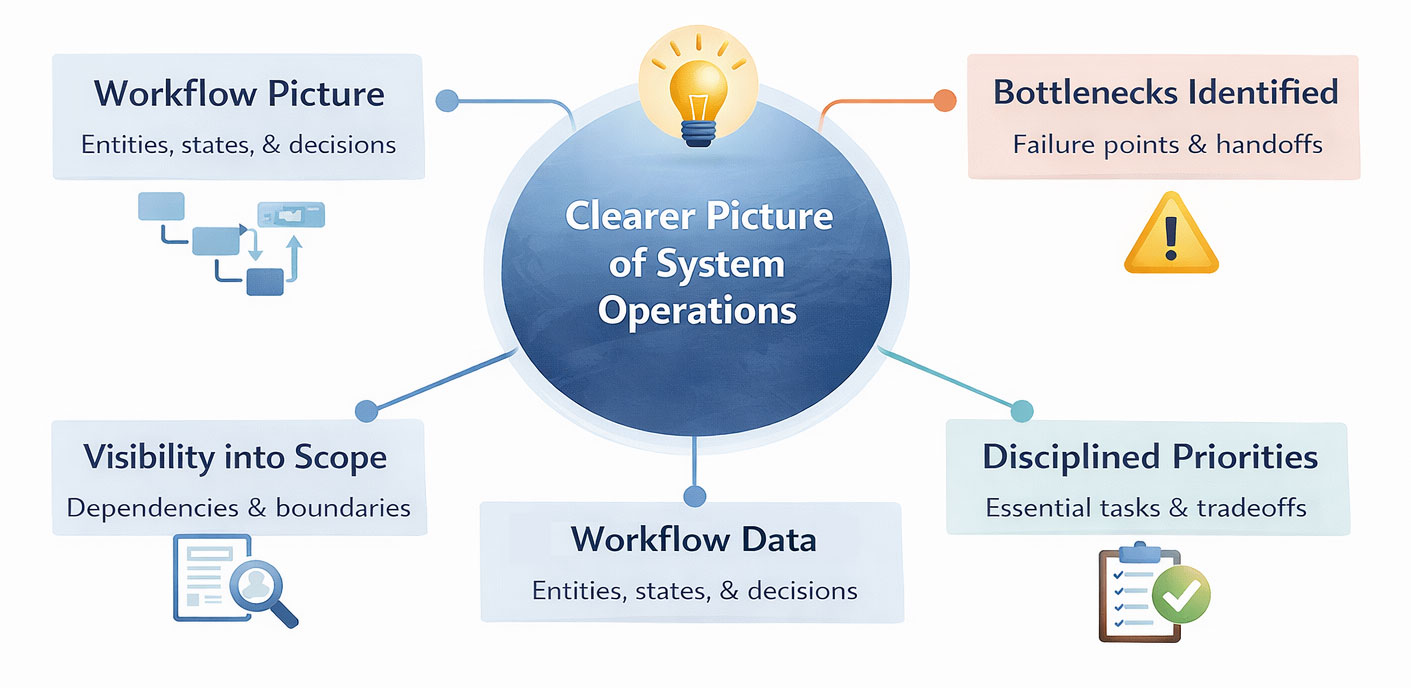
By the end of a strong discovery process, the organization should have more than a feature list.
It should have:
- A clearer picture of the workflow
- Visibility into bottlenecks and failure points
- An understanding of the underlying entities, states, decisions, and dependencies
- A more disciplined view of scope
That is what makes later execution more focused.
What happens without discovery
Without discovery, teams often move into build with a partial understanding of what they are trying to support.
The result is usually one of two problems:
- The system is too shallow to handle operational reality
- The system becomes unnecessarily complicated as hidden dependencies emerge late and are patched in under pressure
The SongSwift approach
At SongSwift, discovery is approached as practical systems work.
The goal is not to produce abstract recommendations detached from implementation. The goal is to clarify the system enough that decisions about architecture, workflow design, data structure, AI fit, and phased delivery can be made on solid ground.
The bottom line
If the challenge is real complexity, the most useful next step is not jumping to a solution.
It is making the system legible first.
Share this article:
If your organization is facing real operational complexity and needs clarity before building, the next step is a Systems Discovery conversation.
All serious engagements with SongSwift begin there.
If your organization is facing real operational complexity and needs clarity before building, the next step is a Systems Discovery conversation.
All serious engagements with SongSwift begin there.