
When Off-the-Shelf Software Stops Fitting the Business
|
Category: Systems Stragegy Author: Adam Clark Miller Publish date: 2026-04-01 |

Organizations rarely start with a custom software problem. They gradually accumulate workaround after workaround until the stack no longer reflects how the business actually operates.
How the drift happens
That drift is easy to miss while it is happening.
At first, off-the-shelf tools feel practical. They are quick to adopt, lower-friction to buy, and often sufficient for an earlier stage of a business or program. A team can launch with spreadsheets, project tools, forms, customer platforms, reporting layers, and a few manual processes to fill the gaps. None of that is inherently a mistake.
The problem comes later, when the organization grows more complex than the stack it inherited.
When the business outgrows the stack
A process that once had a few straightforward paths now includes edge cases, approvals, exception handling, multiple actors, policy constraints, historical reporting requirements, or linked operational stages. The business adapts, but the system does not. Instead of rethinking the operating backbone, the team adds another workaround.
- A new field in a spreadsheet.
- A manual review step.
- A separate tracking document.
- An inbox-based process.
- A duplicated data entry step.
- A custom report built outside the source system.
- A staff member who knows how the handoff really works.
Individually, none of these may seem alarming. Together, they gradually create a stack that no longer matches the shape of the work.
The real signal that something is wrong
This is usually the point at which leaders begin to feel that operations have become strangely fragile. Work still gets done, but too much depends on memory, vigilance, and effort that the formal system does not capture. Teams reconcile information across tools. Definitions drift. Reporting requires interpretation. Small changes create outsized disruption because no one can see clearly how many moving parts are connected.
That is often the real signal that off-the-shelf software is no longer fitting the business.
The issue is not simply that the tools are imperfect. The issue is that the organization has moved into a level of complexity that requires a more coherent system than the existing stack can provide.
Warning signs leaders should look for
Several warning signs tend to appear.
- One is duplicated effort. The same information is entered more than once because different systems require it in different forms or because downstream work cannot rely on upstream records.
- Another is workflow fragmentation. A process that appears unified from the outside is actually spread across forms, inboxes, spreadsheets, separate platforms, and undocumented handoffs.
- Another is conflicting logic. Different teams may be operating from slightly different definitions, states, or rules because no single system enforces the structure consistently.
- Reporting problems are another common indicator. Leaders ask for a simple operational view and discover that the answer depends on manual reconciliation, subjective interpretation, or data that was never modeled in a consistent way.
- Then there is reliance on institutional memory. Certain people become essential not only because they are capable, but because they carry the unwritten logic of the workflow in their heads.
When the stack starts shaping the business
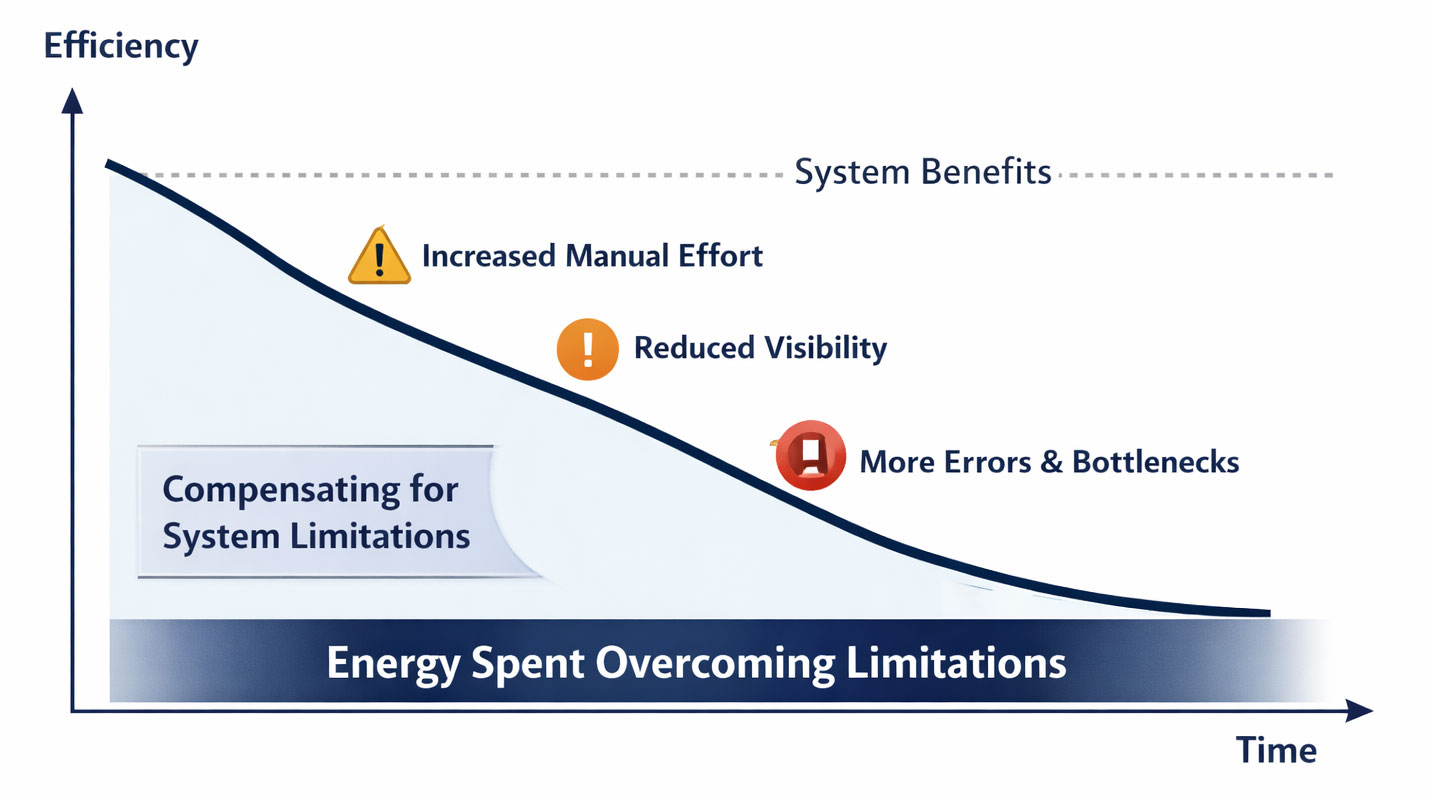
At that point, the organization is often spending significant energy compensating for the limitations of the system rather than benefiting from the system itself.
This is where the conversation about custom software usually begins. But it should begin carefully.
Not every messy process requires a custom platform. Sometimes the problem is governance, process discipline, role clarity, or misuse of existing tools. Sometimes a workflow needs redesign before it needs software. Sometimes the stack can still support the business if the underlying logic is cleaned up and ownership is clarified.
That is why the question is not simply whether off-the-shelf software has limitations. The question is whether those limitations are now shaping the business more than the business is shaping the system.
That is the turning point.
What changes after that turning point
When a team starts bending its operations around disconnected tools, rather than using tools to support a coherent process, the cost of staying fragmented rises. The organization loses visibility. Change becomes harder. Exceptions become more dangerous. Reporting becomes less trustworthy. Scale increases effort instead of improving leverage.
When a custom system makes sense
A custom operational backbone is one way to solve that, but only when the underlying system has been understood clearly enough to warrant it. Done well, a custom system can unify workflow states, preserve critical business logic, support reporting at the data-model level, reduce duplicated effort, and make the operation more legible over time.
Done poorly, it can simply hard-code confusion into a new interface.
The bottom line
If your tools no longer reflect how the business actually operates, the real question is not which workaround to add next. It is what kind of system the organization now needs in order to work with more clarity and control.
Share this article:
If your organization is facing real operational complexity and needs clarity before building, the next step is a Systems Discovery conversation.
All serious engagements with SongSwift begin there.
If your organization is facing real operational complexity and needs clarity before building, the next step is a Systems Discovery conversation.
All serious engagements with SongSwift begin there.