
The Difference Between an AI Feature and an AI System

|
Category: AI Explained Author: Adam Clark Miller Publish date: 2026-03-30 |
An AI feature can look impressive in a demo while doing almost nothing to improve operations.
Why this distinction matters
That distinction matters more than many organizations realize. Software buyers have been shown an endless stream of AI-enabled features: assistants that draft text, tools that summarize records, interfaces that answer questions, modules that suggest next steps. Some are genuinely useful. The problem is that they are often presented as if they amount to transformation on their own.
Usually they do not.
What an AI feature actually is
An AI feature is typically a discrete capability attached to a product or workflow. It may summarize, classify, draft, suggest, or retrieve. It performs a task. Sometimes that task is valuable. But it remains bounded to a narrow point of interaction.
What makes an AI system different
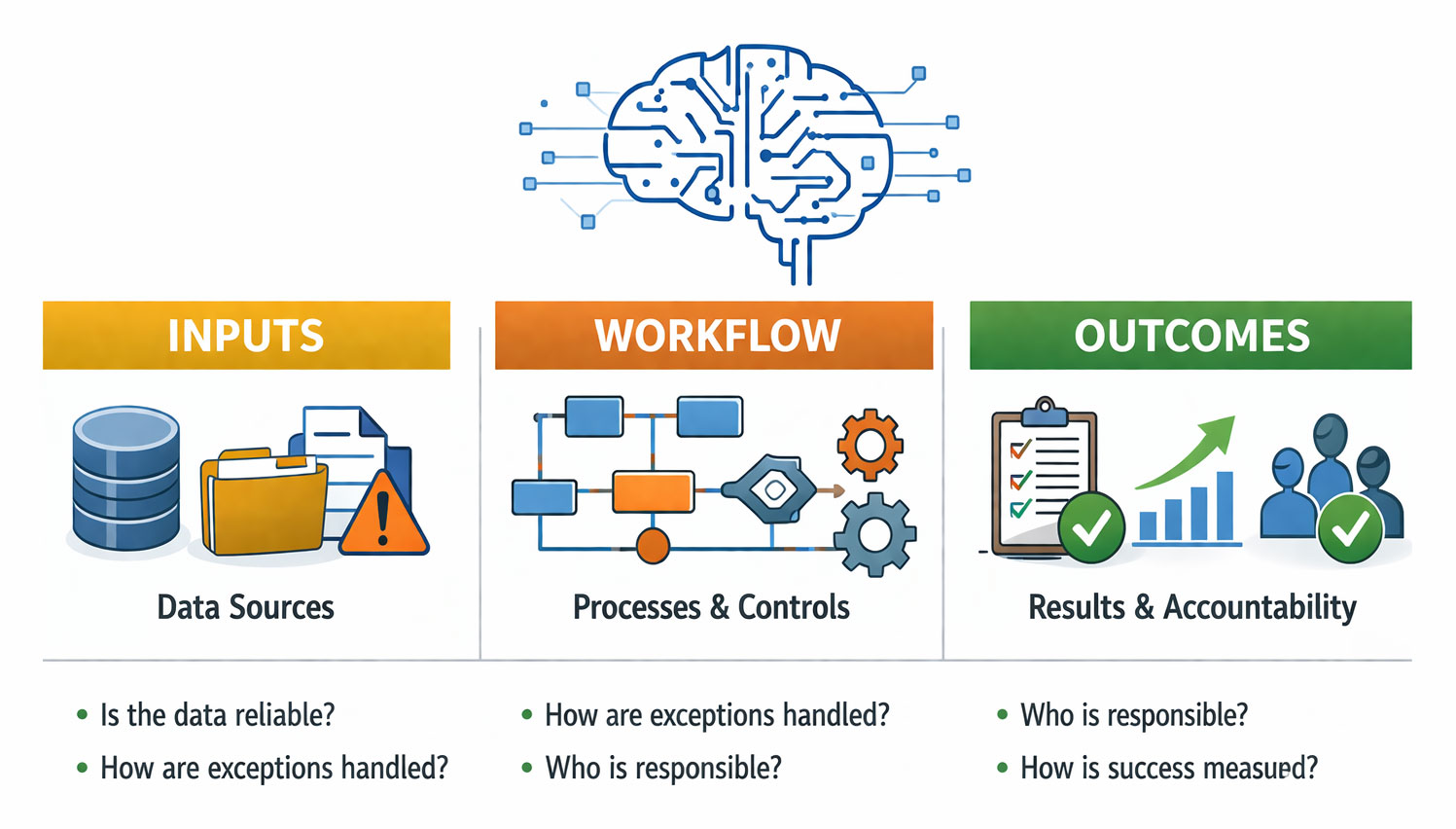
An AI system is different. A system is not defined by a single capability. It is defined by the structure around the capability: the inputs it depends on, the workflow it participates in, the rules it must respect, the states it can influence, the exceptions it must surface, the humans it must coordinate with, and the record it leaves behind.
Why demos can be misleading
This difference is easy to overlook when organizations are evaluating AI quickly. A demo can make a feature feel much larger than it is. A summarization panel may appear to solve information overload. A recommendation engine may seem to accelerate decisions. A classification tool may look like a path to automation. But if the surrounding workflow remains fragmented, if the data is inconsistent, if there is no defined escalation path, and if reporting cannot account for what the system did, the operational value tends to be shallow.
The feature may help at the point of use, but it does not change how the work actually moves.
A practical comparison
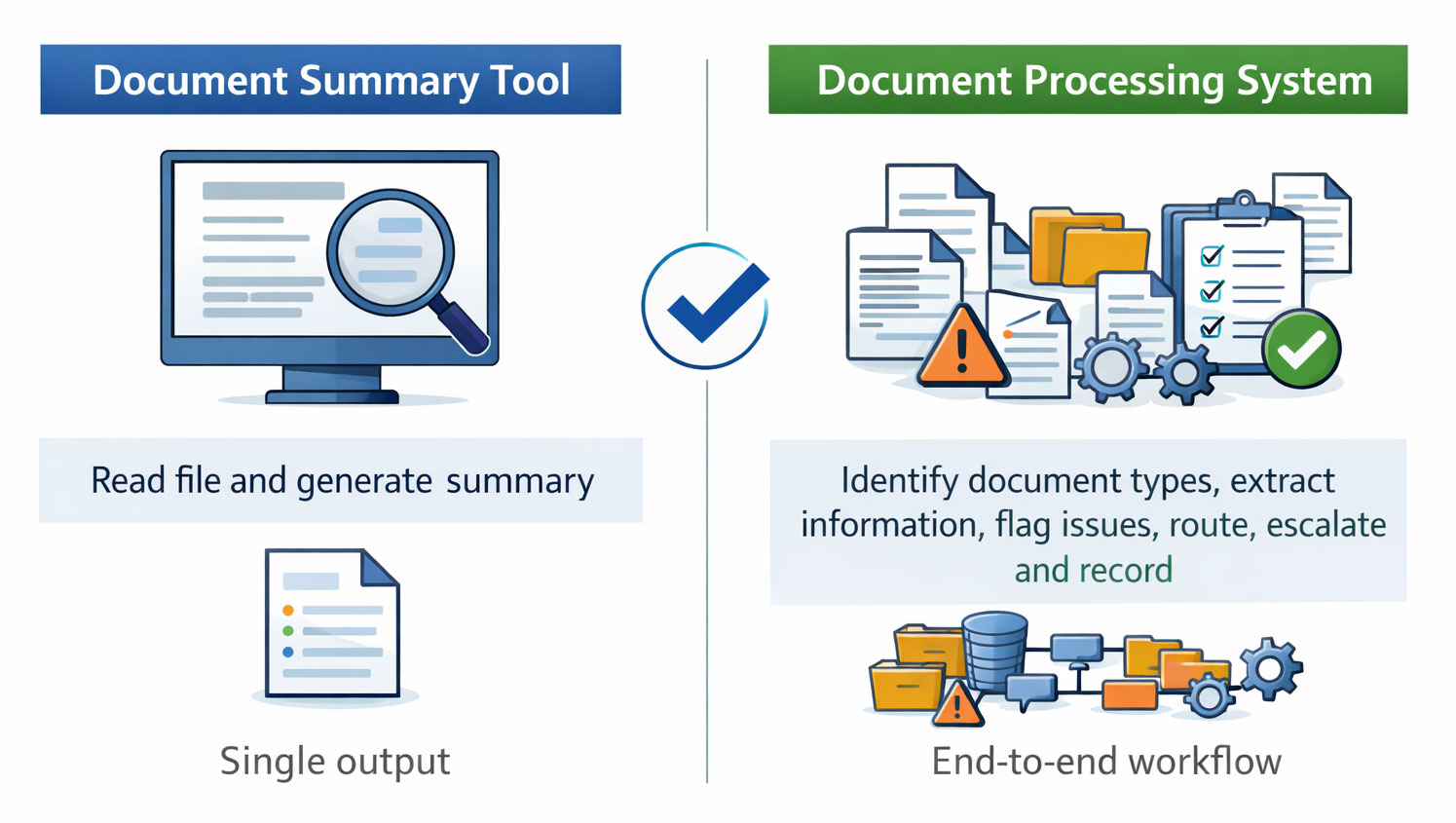 Consider the difference between a document summary tool and a document-processing system.
The first may read an uploaded file and produce a short explanation of what it contains. That can be helpful. It may save time for an individual user.
The second takes in a document set, identifies document types, extracts relevant fields, checks whether required information is present, flags inconsistencies, routes cases based on defined criteria, escalates exceptions, records what happened, and supports downstream action. That is not a single AI trick. It is an operational structure.
Both may use similar underlying models. But they do not occupy the same role inside the business.
Why organizations get disappointed
This is one reason organizations sometimes feel disappointed after adopting AI capabilities that seemed promising at first. The feature works more or less as advertised, but the process still feels messy. Teams are still reconciling information across tools. Approval paths are still opaque. Exception handling still depends on institutional memory. Reporting still relies on manual reconstruction. The feature improved a step. It did not improve the system.
Features are useful — but they are not enough
That does not mean features are unimportant. In many cases, they are useful building blocks. The mistake is not having them. The mistake is confusing them with a more complete operational solution.
What real systems require
Systems require more.
- They require structured thinking about workflow.
- They require a clear data model.
- They require ownership.
- They require permissions.
- They require the handling of exceptions, not just ideal cases.
- They require enough traceability that the organization can understand what happened when something needs review.
- They require a relationship with the rest of the operating environment.
This is why systems are harder to design and more consequential to get right. They do not sit on top of the work. They become part of how the work is done.
How buyers should evaluate AI more carefully
For buyers, this creates a more useful way to evaluate what is being offered. Instead of asking only what the AI can do in isolation, ask how it fits into the full workflow.
-
- What inputs does it rely on?
- What state changes can it cause?
- How are edge cases handled?
- What happens when its output is uncertain?
- Who is accountable for review?
- How is the outcome recorded?
- What downstream processes depend on the result?
If those questions do not have clear answers, the organization is probably looking at a feature, not an operational system.
The bottom line
A feature can improve convenience. A system can improve operations.
If the goal is real improvement rather than a surface-level enhancement, the design conversation has to start at the system level.
Share this article:
If your organization is facing real operational complexity and needs clarity before building, the next step is a Systems Discovery conversation.
All serious engagements with SongSwift begin there.
If your organization is facing real operational complexity and needs clarity before building, the next step is a Systems Discovery conversation.
All serious engagements with SongSwift begin there.